
Before any flight, even before thinking about movements or technical settings, there is one decision that defines the entire visual narrative: the setting. It’s not just about choosing a beautiful location, but rather selecting an environment that communicates, reinforces an idea, and provides context for the image.
In the world of drones, the setting functions as a language. It shapes emotions, guides the viewer’s gaze, and determines how the viewer interprets each movement. The same flight can convey freedom, tension, or contemplation—it all depends on the space where it takes place.
In this article, HPDRONES will explore how to intentionally choose the right setting, analyzing visual elements, the influence of light, the importance of perspective, and the direct relationship between environment and camera movement.
The setting is the first creative decision
The same aerial maneuver conveys completely different sensations depending on the environment.
- Sea: Conveys freedom and scale;
- Urban environment: Conveys rhythm and density;
- Natural setting: Reinforces tranquility and authenticity.
What defines a “good” composition?
A good composition isn’t necessarily the most impressive one; it’s the most intentional one. There are four key elements to consider.
- Clear visual flow: Lines, shapes, and patterns help the eye navigate the image with fluidity and purpose.
- Presence of a subject: Even in wide shots, there should be a focal point that anchors the narrative.
- Contrast and depth: Light, shadow, and variation in elements create dimension and visual expression.
- Alignment with the objective: The scene should reinforce the message.
The Importance of Light in a Scene
The same location can produce completely different results throughout the day.
- Golden Hour: Greater visual impact. Warm color temperature and pronounced textures.
- Midday: Flatter, less expressive images. Short, harsh shadows.
- Blue Hour: An emotional and dramatic tone. Ideal for sophisticated brand narratives.
Altitude and Perspective
The setting is not just the location; it is also how we see it. Changing the altitude completely transforms the visual experience.
- Low Altitude (0–20 m): Proximity and immersion. The viewer feels as though they are inside the scene.
- Medium Altitude (20–80 m): Balance between subject and context. A complete and balanced narrative.
- High Altitude (80–120 m): Patterns, scale, and abstraction. Reveals the hidden geometry of the space.
The Right Movement for Every Moment
Every camera movement communicates something different. The combination of the chosen setting and the executed movement determines the emotional language of the final image.
Dolly In / Dolly Out
- Linear forward or backward movement, highly narrative-driven.
- Moving closer creates engagement and urgency; moving away conveys scale or isolation.
- Ideal for revealing key elements or closing scenes.
Orbit
- Circular motion around a subject while keeping it centered.
- Emphasizes importance and presence.
- Works well with buildings, monuments, and people.
Reveal
- Gradual reveal from behind an obstacle or vertical rise.
- Builds anticipation and delivers strong emotional impact.
- Ideal for landscapes, sunrise cityscapes, and large structures.
Tracking
- Following a moving subject with continuous framing.
- Creates energy, rhythm, and immersion.
- Common in sports and lifestyle content.
Crane Up
- Slow vertical ascent revealing surroundings.
- Conveys scale and grandeur.
- Great for showcasing locations.
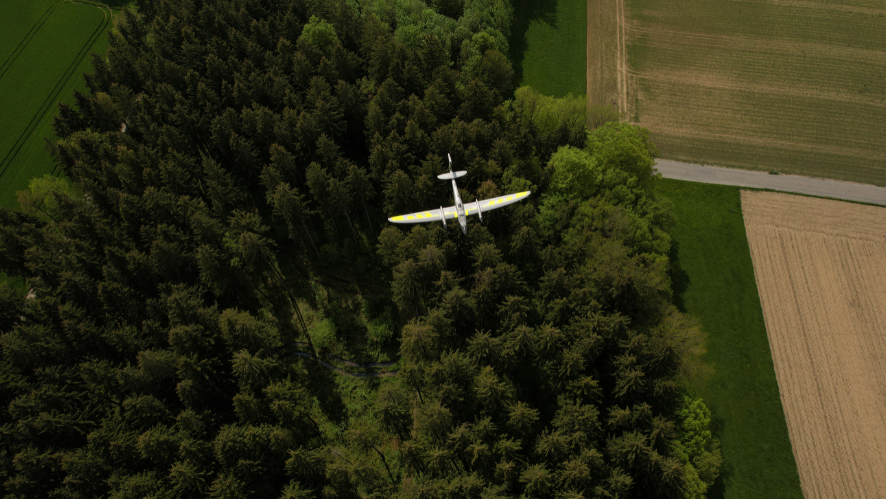
Top Down
- Camera facing straight down (90°).
- Highlights patterns, geometry, and textures.
- Ideal for architecture, crowds, and natural patterns.
Hyperlapse
- Continuous movement combined with time-lapse.
- Captures time and motion together, conveying energy and scale.
- Ideal for cities, events, and dynamic environments.
Choosing the perfect setting for a flight isn’t a matter of luck or just aesthetics—it’s a strategic decision. Every element, from the light to the altitude to the type of movement, contributes to creating a coherent and impactful visual narrative.
And on your next flight, will you choose a beautiful setting… or a setting with a purpose?