



The transition to Industry 5.0 requires more than automation; it requires adaptive physical intelligence. With the proliferation of advanced robotic platforms, the decision between humanoid (bipedal) and quadruped (four-legged) designs has become the new strategic dilemma for operations directors and innovation leaders.
In this article, HPDRONES will delve into the technical, economic, and operational aspects that define the success of robotic integration in complex industrial environments.
1. The Science of Locomotion and Dynamic Stability
The choice between two or four legs is not merely aesthetic; it is a decision based on physics and control theory.
Quadruped Robots: The Triumph of Static and Dynamic Stability
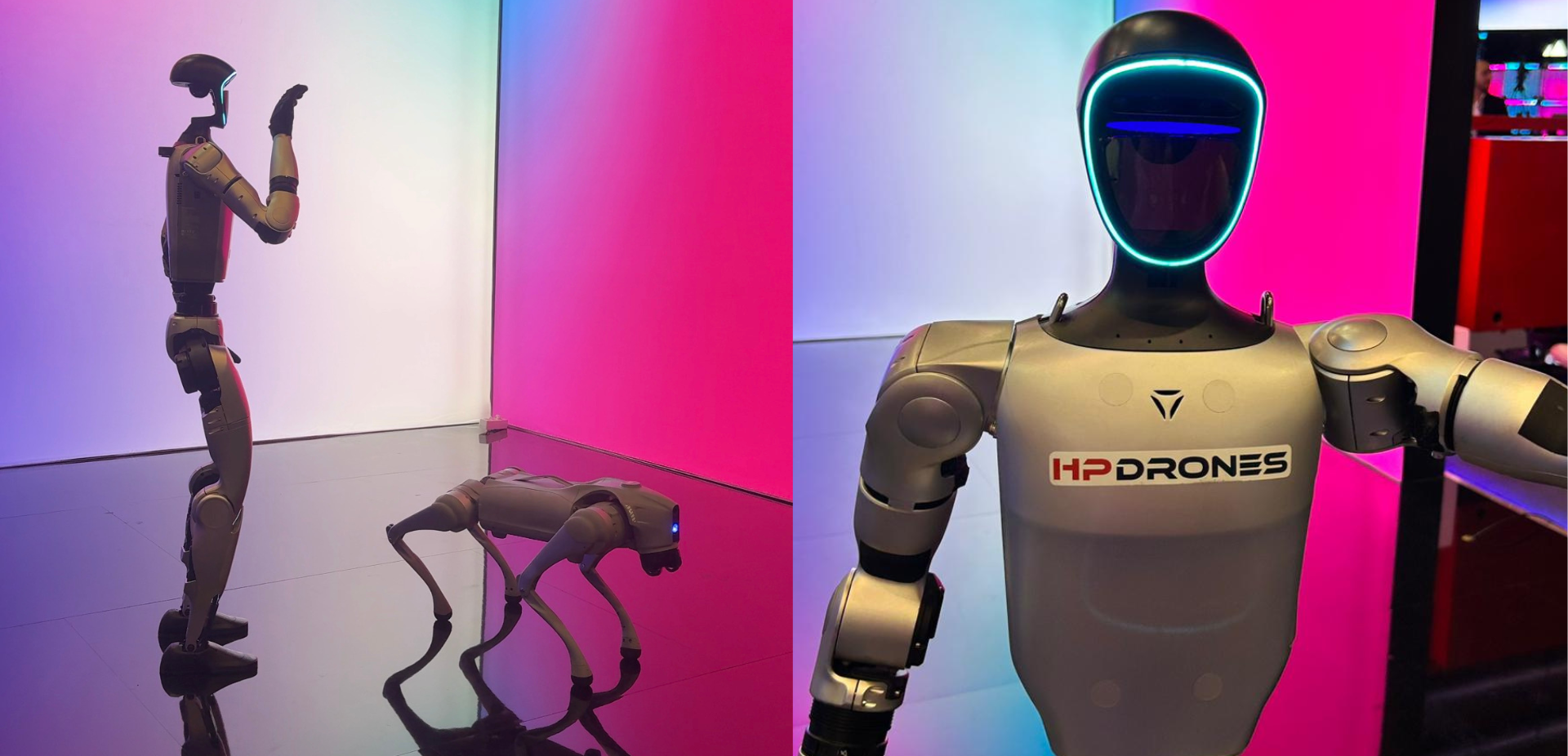
Quadruped robots, such as the Unitree Go2, operate with a superior level of stability. At all times, they can maintain three points of contact with the ground, ensuring inherent static stability.
- Leg force control: Modern algorithms allow each leg to act as a pressure sensor, adjusting stiffness in milliseconds to absorb impacts or prevent slipping on slippery surfaces.
- Energy cost of transport: Quadrupeds have a significantly lower CoT on both flat and uneven terrain, resulting in operating times that can exceed 4 hours of continuous operation.
Humanoid Robots: The Challenge of Dynamic Balance
Humanoids, such as the Unitree G1, use a Linear Inverted Pendulum model. Balance is maintained through constant adjustments to the center of mass.
- Degrees of Freedom (DoF): While an industrial quadruped typically has 12 DoF, a humanoid can have between 20 and 50. This allows for a range of motion much closer to that of a human, but requires much greater processing power to maintain stability while manipulating heavy objects.
2. Manipulation and Interaction with the Environment
This is the key strategic difference between the two platforms.
- “End-to-end” manipulation (humanoids): The humanoid is designed for bimanual manipulation. This means it can hold a part in one hand and work on it with the other, or carry bulky objects against its chest. The integration of computer vision and neural networks allows the robot to learn tasks through human demonstration (imitation learning).
- Coupled manipulation (quadrupeds): For a quadruped to manipulate objects, it needs a robotic arm mounted on its back. This alters the center of gravity and limits dexterity, making it more suitable for simple “pick-and-place” tasks or for operating isolated switches and valves.
3. Software Integration and the Digital Ecosystem
True intelligence lies not in the hardware, but in the code. The trend for 2026 is a shift toward open systems.
- ROS 2 and middleware: both platforms must be integrated into the factory’s digital twin. Through robust APIs, robots communicate with the company’s ERP/MES system, autonomously reporting anomalies or requesting maintenance.
- Reinforcement Learning: We no longer program every step. Robots are trained in virtual environments where they simulate millions of hours of movement and manipulation before being deployed on the actual production floor.
4. Analysis of Return on Investment and Economic Feasibility
| Cost factor | Four-legged robot | Humanoid robot |
| Purchase price | Medium (mature technology) | Advanced (state-of-the-art technology) |
| Maintenance costs | Low (fewer moving parts) | Advanced (Complex Actuators) |
| Completion deadline | Quick (Weeks) | Slow (Months of training in specific tasks) |
| Versatility in tasks | Specialized (Inspection/Safety) | Generalist (Production/Logistics) |
The return on investment for a quadruped robot is evident almost immediately in the reduced risks to personnel during inspections. The return on investment for a humanoid robot is long-term and centers on the flexibility offered by replacing multiple specialized machines with a single, versatile agent.
5. Conclusion: How to Decide?
Looking ahead to 2026, the strategic recommendation is clear:
- Implement quadrupeds TODAY if: You need moving eyes and sensors in dangerous, dark, or dirty environments. It is the solution for surveillance and security.
- Invest in humanoids NOW if: you are designing the factory of tomorrow, where human labor will be scarce and you need a machine capable of learning any manual task. It is the solution for agility and resilience.
The revolution isn’t about which robot is better, but how your company uses physical intelligence to gain a competitive advantage.
Ultimately, the decision comes down to a matter of vision: humanoid or quadruped? Which robot is best suited for your industrial operation?